Ideas
New hire welcome kit merch that doesn't get left in a drawer
Most onboarding swag is bought once, in bulk, in the wrong sizes. Here is how to build a welcome kit people keep — and a way to run it that does not leave you with a closet full of mediums.
Home \g<1>New hire welcome kit merch\g<2>
Why most onboarding swag fails
The standard playbook is to order 200 units of a logo tee in a size curve someone guessed at in 2023, stack the boxes in a supply closet, and hand one to each new hire on day one. It fails for three reasons, and they compound.
The first is fit. A shirt that does not fit is not worn, and roughly a third of any pre-guessed size curve lands wrong. The second is choice. A person who is handed a garment has received an object; a person who picked the color and the design has received something that is theirs. The third is timing — the closet order was designed for last year's brand, last year's headcount, and last year's remote-vs-onsite split, and none of those held.
The tell is easy to spot. If your supply closet has more XL than anything else and you keep running out of small, the guess was wrong, and it has been wrong for a while.
What belongs in a kit people keep
The pieces that survive past week two have one thing in common: they are things the person would have owned anyway. That narrows the list considerably.
One good outer layer. A midweight hoodie or a quarter-zip does more brand work over a year than five tees, because it gets worn in situations where people are seen. If the budget only supports one nice item, make it this one.
Something for the desk that is not branded to death. A quality tote, a decent water bottle, or a laptop sleeve with a small mark. Restraint reads as confidence; a logo covering the whole face reads as inventory.
One item that signals the team, not the company. A patch, a sticker set, or a variant design tied to the department or the office. This is the piece that gets talked about, because it says the person joined something specific rather than a corporate entity.
What to leave out: the third tee, the branded stress ball, and anything with a printed year on it. Dated merch has a built-in expiry, and the kits you have left over in March become landfill in January.
The sizing problem has a real fix
Guessing a size curve is the root cause of most onboarding merch waste, and the fix is to stop guessing. Two approaches work.
The straightforward one is a redemption link. New hires pick their size and style in the offer-acceptance flow, and the order is produced against real selections rather than a forecast. This works well for distributed teams and it moves the sizing decision to the only person who knows the answer.
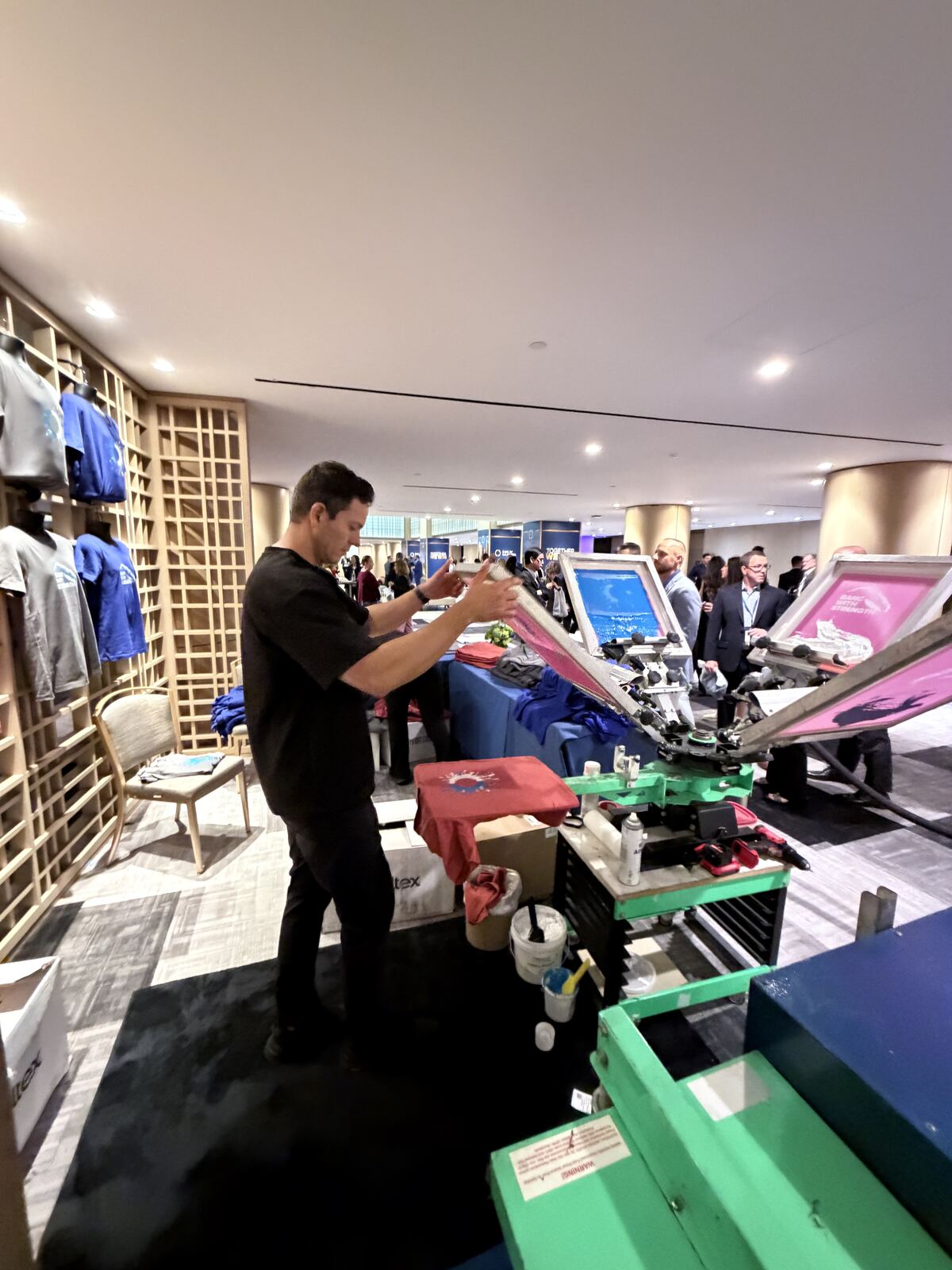
The other is to batch it. Instead of a per-hire kit, run a live printing station for onboarding cohorts — quarterly, or monthly if you are hiring fast. New hires pick a blank off the rack, pick a design from a small menu, and watch it get printed. It takes about two to three minutes a person, and the piece leaves the room already claimed. For a company onboarding twenty to fifty people a quarter, this is usually cheaper than the closet approach once you count the units that were never worn.
The second version also does something the first cannot: it makes day one memorable. We have run this format for teams at Hyundai and Sony, and the consistent feedback is that the station becomes the part of orientation people photograph. That is not nothing when the rest of the day is benefits enrollment and a security badge.
Budget, lead time, and the sustainability question
Plan on a per-person figure rather than a total, because it makes the tradeoffs visible. A single quality outer layer plus one small item is the tier most companies land on. Adding a second garment roughly doubles the number without doubling the impression.
On lead time: blanks for hoodies and quarter-zips run longer than tees, especially heading into Q4 when everyone is ordering at once. If you want a specific color in a specific fabric for a January cohort, decide in the fall. Print-on-demand and live printing both compress the artwork timeline, but neither compresses blank availability.
On sustainability, produce-to-order is the honest answer. Nobody's ESG report benefits from 60 unworn shirts. Printing what people actually selected, in the size they actually wear, removes the waste at the source rather than offsetting it later.
A simple structure that works
If you want one recommendation: run onboarding merch as a quarterly event rather than a per-hire transaction. Hold a cohort welcome session, bring in a live station, let people build their own piece, and keep a small buffer of pre-made kits for anyone who starts off-cycle or works remotely. You get the memorable moment, you produce against real demand, and the supply closet stays empty.
Straight answers
Related questions
How many pieces should a new hire kit include?
Two or three is the sweet spot. One good outer layer, one useful non-apparel item, and optionally one small team-specific piece like a patch or sticker set. Beyond that you are adding cost without adding much that gets kept.
What if we hire continuously rather than in cohorts?
Run a small stock of pre-made kits in the three most common sizes for off-cycle starters, and hold a live printing session quarterly for everyone who joined since the last one. The session becomes a natural cross-cohort mixer, which is a second benefit.
Can you print onto items we already have in the closet?
Usually yes, if the blanks are still in good shape and the fabric takes a transfer or a screen print. Sending us photos and the fabric content of what you have is the fastest way to get a straight answer, and it is often the cheapest path to clearing old inventory.
Start a quote
Tell us about the event once.
Share the date, city, headcount, and the pieces you have in mind. We come back with a station plan, staffing, and a real number — not a fill-in-the-blank price sheet.
Prefer to talk it through? Call (562) 614-4800.